 Contact

Human Rights & Diversity
- Promotion Structure
- Policies on Human Rights and Diversity
- Human Rights Due Diligence
- Training on Human Rights and Diversity
- Human Rights and Diversity Initiatives
- Initiatives on Respect for Human Rights
- Promotion of the understanding of issues faced by LGBTQ people
- Promotion of Advancement for Women in the Workplace
- Employment of People with Disabilities
- Establishment of Universal Guidelines
- Workplace Environments with Active Roles for Non-Japanese Employees
- Post-Retirement Life Plan Support
- Points of Contact for Consultations
The Yamato Group's Corporate Stance under its Group Corporate Philosophy advocates respect for human rights in all business activities. As a signatory of the UN Global Compact, we also support and respect The Ten Principles of the UN Global Compact and international norms* regarding human rights. In addition to engaging in business activities that take the human rights of all stakeholders into consideration, we also prohibit any and all forms of discrimination or harassment based on the guidelines for recognizing, accepting and utilizing individual differences (including age, gender, nationality, disabilities, sexual orientation and gender identity) and values.
The social environment is currently undergoing major changes, and the needs of society are diversifying rapidly. In order for us to respond flexibly to these changes, it is necessary to increase the diversity of human resources active within our organization.
By promoting diversity and respect for human rights, we aim to be an internationally competitive corporate group that is resistant to market changes.
- *The U.N. Guiding Principles on Business and Human Rights, International Bill of Human Rights, Declaration On Fundamental Principles and Rights at Work, etc.


Sustainability Metrics and Targets (2024–2026)
- Ensure 100% of employees participate in human rights and anti-harassment training
- Ensure 6.5% of all managers are women
- Ensure percentage rate of employees with disabilities is 3.1%
For detailed targets and results, please refer to Sustainability Strategies, Goals and Results.
Promotion Structure
The Yamato Group has established the EX Promotion Committee and the Human Rights and Diversity Subcommittee to further promote respect for human rights. The Managing Executive Officer in charge of human resources is responsible for, and serves as the chairperson for, these committees. The committees consider and check the progress of strategy measures relating to human rights issues within the Yamato Group, and strive to raise awareness with regard to such.
Policies on Human Rights and Diversity
Yamato Group Human Rights Policy
The Yamato Group established the "Yamato Group Human Rights Policy" in 2021 based on the UN Guiding Principles on Business and Human Rights, with the aim of realizing a enriched society as stated in the Group's Management Philosophy. This commitment indicates the Yamato Group's intention and direction to respect human rights through a resolution of the Board of Directors. Based on this policy, we will strengthen our efforts to respect human rights.
 Yamato Group Human Rights Policy[PDF:512KB]
Basic Policy on Diversity
We have established a Basic Policy on Diversity with the aim of creating a workplace environment that respects the diversity of employees, fosters diverse human resources, and enables them to engage in active roles. Based on the Yamato Group's "DNA" and core value of management by full participation (we all represent the company), we promote diversity throughout the Group by creating a workplace environment where diverse human resources can play an active role and fostering diverse human resources.
Human Rights Due Diligence
The mission of the Yamato Group as a social infrastructure company is to continue contributing to the creation of an enriched society. Over the course of conducting business in collaboration with diverse stakeholders, including customers, business partners, local communities, and employees both inside and outside Japan, we recognize our responsibility as a company that respects human rights.
By implementing procedures to identify, prevent, and correct negative impacts on human rights, including in our supply chain, in line with the UN Guiding Principles on Business and Human Rights, we engage in respecting the human rights of all people. Accordingly, we have created a mechanism for human rights due diligence to fulfill our responsibilities as a company toward respect for human rights.
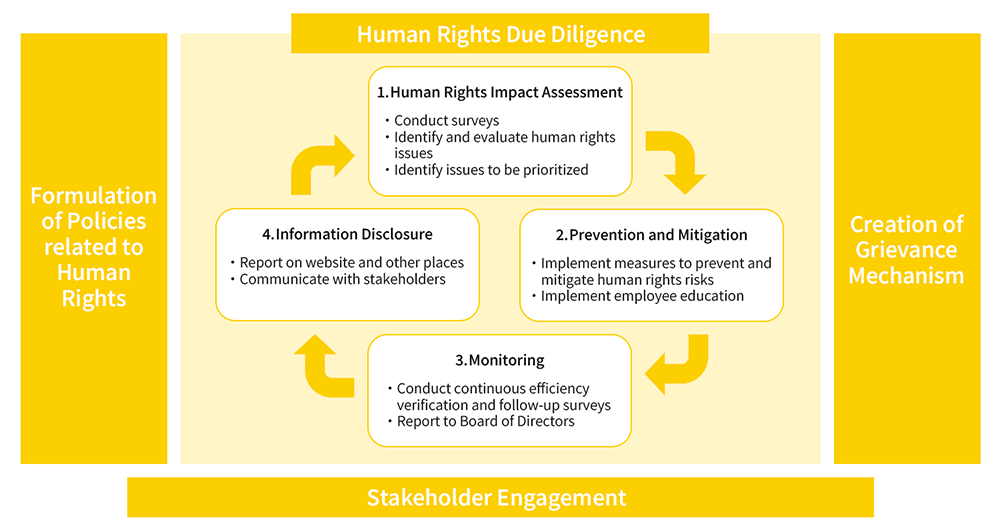
Human Rights Impact Assessment
As part of the human rights due diligence process, the Yamato Group implements human rights impact assessments for all of our business activities and systematically implements regular reviews of risk mapping for latent issues.
In fiscal 2024, we implemented assessments for the negative impact of our business on human rights, identifying human rights issues by conducting interviews and surveys of our companies and supply chains. We assess the human rights risks of issues identified by calculating their severity and possibility of occurrence based on human rights indices announced by international institutions and other bodies, mapping the results, and implementing initiatives for these issues to reduce risks. We also receive and apply support and advice from external experts regarding identifying human rights risks.
| Step 1 Organization and Surveys of Human Rights Issues |
|
|---|---|
| Step 2 Identification and Assessment of Human Rights Issues |
|
| Step 3 Identification of Issues to Be Prioritized |
|
* References “Research on Business and Human Rights: How Companies Should Respond to Business and Human Rights Today” published by the Center for Human Rights Education and Training
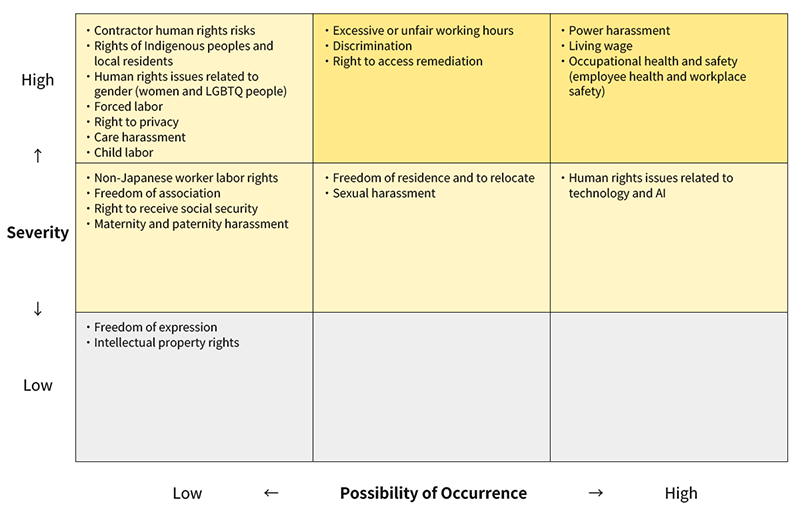
The results of the human rights impact assessment identified six issues with particularly high severity and possibility of occurrence as ones to be prioritized.
・Power harassment
・Right to access remediation
・Occupational health and safety (employee health and workplace safety)
・Discrimination
・Living wage
・Excessive or unfair working hours
Initiatives to Mitigate Key Human Rights Risks
We implement the following initiatives to mitigate human rights risks identified through the results of the human rights impacts assessment as issues to be prioritized.
| Human Rights Risks | Outline of Mitigation Measures |
|---|---|
| Power harassment Discrimination |
|
| Right to access remediation |
|
| Occupational health and safety (employee health) |
|
| Occupational health and safety (workplace safety) |
|
| Living wage |
|
| Excessive or unfair working hours |
|
Additionally, we have set issues to be addressed and goals to be achieved under the Yamato Group Medium-Term Management Plan “Sustainability Transformation 2030~1st Stage~” and aim to steadily achieve these goals. For more details, please see Sustainability Strategies, Goals, and Results.
Monitoring
Group sustainability initiatives, including human rights due diligence, are reviewed by the Yamato Group Social Promotion Committee, which is chaired by the President, and reported to the Board of Directors.
Information Disclosure
We report human rights initiatives to all stakeholders through methods including our corporate website, Integrated Report, and Annual Securities Report.
Training on Human Rights and Diversity
Harassment Prevention Training
The Yamato Group distributes mini booklets explaining its Group Corporate Philosophy to all employees, to enlighten them about the Group's stance on human rights and the importance of respecting human rights. We also create a Group-wide harassment handbook, and conduct training for all employees with the objectives of understanding human rights and preventing harassment. In particular, we educate management personnel, using videos, to enable them to respond appropriately when they receive a report or consultation on human rights issues, including bullying or harassment.
Participation in Yamato Original Universal Manners Test

Yamato Transport has implemented a universal manners test to enhance the universally applicable manners of employees and contribute to achieving a society that respects human rights and diversity.
Through the Yamato Original Universal Manners Test, participants can learn about the difficulties faced by people with disabilities and how to provide appropriate support. Managers and senior executives have started taking the test, which is based on a proprietary curriculum tailored to daily operations, envisaging scenarios of picking up and delivering packages. Approximately 35,000 full-time personnel took the test in FY2024, and in total approximately 58,000 personnel have completed it.
The Universal Manners Test (held by Miraro Inc.*) is a test to systematically acquire the knowledge about the mindset and actions needed for universal manners.
* The Yamato Group concluded an agreement for business collaboration and capital alliance with Mirairo Inc. in 2021.
Human Rights and Diversity Initiatives
Initiatives on Respect for Human Rights
The Yamato Group engages with outside experts on human rights risks and considerations in its business activities. At a stakeholder dialogue held in November 2019, Ryusuke Tanaka, Program Officer of the International Labour Organization (ILO) office in Japan, gave opinions on human rights issues across a wide range of topics, such as labor and supply chain. Going forward, we will continue to incorporate valuable opinions from third-party perspectives into the identification of material issues and consideration of strategies, and make use of them in future initiatives.
Promotion of the understanding of issues faced by LGBTQ people
It is said that many sexual and gender minorities work in the transportation industry because the differences in the appearance of uniforms worn by male and female employees are minor in comparison with other industries. In order to help create a workplace environment where sexual and gender minorities can engage in active roles in the future, we carried out training for all employees with the goals of better understanding of LGBTQ people and sexual orientation and gender identity (SOGI) harassment prevention. Furthermore, we have established an external consultation point of contact for employees. It deals with workplace issues related to the sexual orientation and gender identity of the person themselves and also questions about consideration and support from managers and coworkers. At the point of contact, external counselors who have knowledge and understanding of LGBTQ people (LGBTQ people themselves and professional counselors) provide consulting services so users can have peace of mind that their privacy will be taken into consideration and details of consultations and personal information will not be shared with the company without their express permission.
- *LGBTQ is a general term for sexual minorities. It is an acronym for lesbian, gay, bisexual, transgender, and queer/questioning.
Promotion of Advancement for Women in the Workplace
The Yamato Group is developing initiatives in collaboration with Group companies to promote the advancement of women employees.
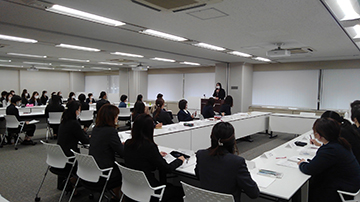
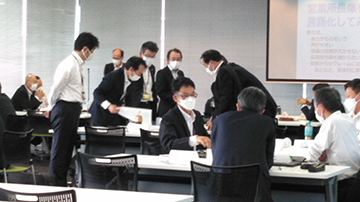
From fiscal 2024, Yamato Transport has been developing a program for women employees aiming to become managers that focuses on supporting their career development. Further, we have newly established a forum (human resource development meeting) for discussing development to support growth as an individual as an organization and provide scheduled one-on-one training. Determining medium- to long-term experience acquisition centered on the candidate’s career aspirations and regularly confirming progress will lead to fostering determination and building their skill set.
Employment of People with Disabilities
The Yamato Group continues to create employment opportunities for people with disabilities based on our Corporate Stance, which states that we will actively support the independence of people with disabilities and other socially vulnerable people. As of March 31, 2025, the Group employs 3,113 people with disabilities, an employment rate of 3.35%.
From fiscal 2025, we will expand the scope of duties for employees in charge of recruiting people with disabilities, who were previously deployed nationwide by Yamato Transport, to include disability welfare activities. They will also be deployed to other Group companies. In addition to sharing issues with promoting recruitment and examples of success through regular meetings for all recruiters, we collaborate with affiliated organizations (Yamato Welfare Foundation, Swan Co., Ltd., and Yamato Jiritsu Center) to expand existing duties and support the establishment of new ones. Furthermore, we implement training for all employees that promotes understanding of reasonable accommodations for with disabilities and encourages changes in their own behavior.
Establishment of Universal Guidelines
The Yamato Group has established universal design guidelines to design facilities that customers and employees can use more at ease and more comfortably.
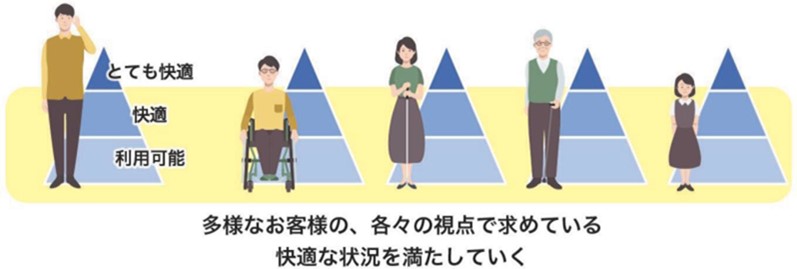
Examples of Universal Design Introduction
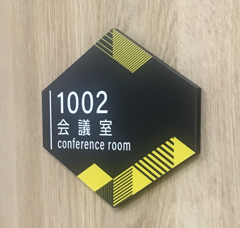
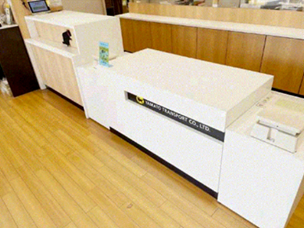
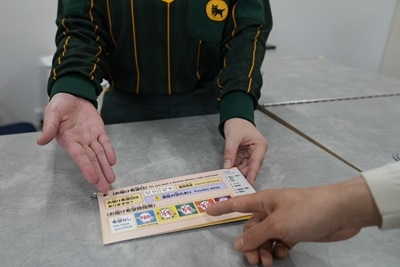
Communication Board
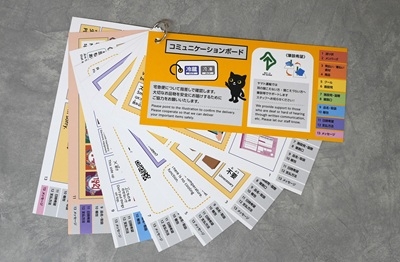
At Yamato Transport, we aim to realize an environment in which all our customers can use our TA-Q-BIN services with peace of mind and comfort, including customers with hearing difficulties and those who use languages other than Japanese. From fiscal 2025, we have introduced a “communication board” developed by Yamato Transport that enables customers to send packages and other procedures by pointing at illustrations and words or characters to 767 sales offices in the Tokyo and Kansai areas.
Workplace Environments with Active Roles for Non-Japanese Employees
The Yamato Group employs approximately 8,000 non-Japanese employees. We provide multilingual documents and notices about employment and safety and work manuals for non-Japanese employees in English, Chinese, Nepali, and Vietnamese. We also provide multilingual support in our employee awareness survey, investigate opinions on job satisfaction and ease of working for non-Japanese employees, and reflect our findings in efforts to improve the workplace environment.
To develop a working environment that enables non-Japanese employees to demonstrate their skills with peace of mind and ensure they are not isolated and left behind, we set up a multilingual consultation center (available in English, Nepali, and Vietnamese) from October 2023.
| Nationality | Number of Employee |
|---|---|
| Nepali | 3,243 |
| Vietnamese | 641 |
| Sri Lankan | 542 |
| Chinese | 349 |
| Brazilian | 182 |
| Korean | 122 |
| Philipino | 118 |
| others | 68 |
* Scope: consolidated companies in Japan and Swan Co., Ltd.
Post-Retirement Life Plan Support
We organize the Yamato Life Plan Seminar, which provides employees approaching retirement about pension plans, how to work after retirement, and financial planning after retirement. Employees can participate in the seminar with their spouses, and receive assistance for them and their families to transition smoothly to their second life after retirement.
Points of Contact for Consultations
The Group's common compliance consultation desks (Corporate Fraud Report Desk, Compliance Hotline and Opinions Box) are available to all Group employees, and also accept reports and consultations on human rights issues, including discrimination and harassment. In all cases, the department in charge investigates in line with internal reporting regulations, taking care to ensure that whistleblowers and consulting employees are protected and do not suffer disadvantages, and taking appropriate measures and action based on internal regulations. The contents of reports by whistleblowers are reported to the Compliance and Risk Committee, and to the Board of Directors on a regular basis.
We have also established a call center and inquiry desk for customers to contact us by phone and e-mail, and an inquiry desk for shareholders and investors on our website.