 Contact

Labor Practices
Promotion Structure
EX Promotion Committees
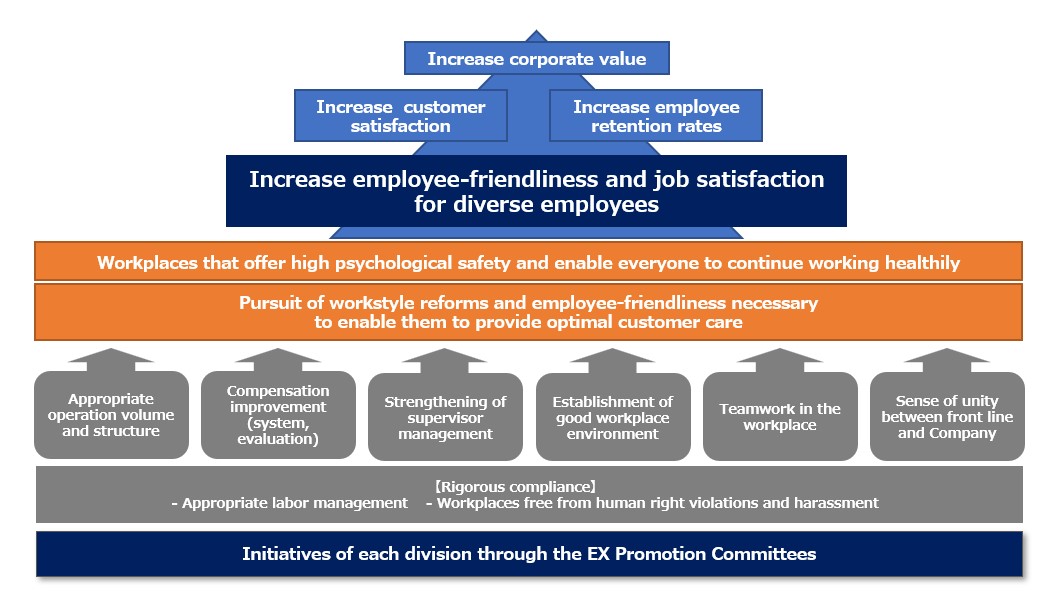
The Yamato Group has established these committees at each Group company to hold discussions on how to increase employees’ pride in their work and sense of satisfaction, and how to promote diversity, and then implement the ideas.
At Yamato Transport, we hold monthly committee meetings chaired by the director in charge of the Human Resources Unit and attended by the Head Office General Manager and labor union representatives. In addition to Employee Awareness Surveys, they decide on initiative themes based on employee opinions collected from each unit. They then carry out initiatives that aim to improve job satisfaction as a whole by implementing concrete measures based on hypotheses.
Labor-Management Relations
The Yamato Group acknowledges employees’ freedom of association, right to organize, and right to collective bargaining, and has formed labor agreements with unions.
Yamato Transport advances labor discussions between the Company and unions (to which approximately half of all employees belong) about the improvement of various systems and the management environment as necessary.
Policy on reduction of working hours
Under the Yamato Group Human Rights Policy, the Group considers overwork to be a serious human rights issue and strives to limit working hours by reducing excessive hours and encouraging employees to take annual paid leave.
 Yamato Group Human Rights Policy[PDF:512KB]
Planned working hours
At Yamato Transport, workers and management set the planned number of working hours in a year to curb long working hours and realize work-life balance.
Each month, progress is checked at a meeting held at each regional branch with workers and management participating. If any workers are found to have particularly long working hours, improvement measures are considered as a first order of priority as part of a commitment to maintaining the planned annual working hours.
Work interval system
Yamato Transport strives to ensure a rest period (interval) of at least 11 hours between the end of work on one day and the start of work on the following day to ensure that employees can have a reasonable amount of rest.
Promoting annual leave utilization
Yamato Transport encourages systematic utilization of annual leave, such as taking a week of continuous leave and taking leave on celebration days. We aim to see individuals use at least 90% of their annual leave.
Decent Work Initiatives
"All-inclusive management"
Each and every Yamato Group employee thinks from the customer's point of view, making decisions and acting on their own initiative. The coming together of its employees is the source of the Yamato Group's power. This is the DNA that we have inherited from generation to generation. A major prerequisite for all-inclusive management is a workplace environment where employees can work actively, and we believe that creating such an environment is the most important issue for management.
The Transformation Plant YAMATO NEXT100 highlights labor as one of the material issues for the next 100 years and aims to contribute to achieving "decent work" by 2030. Under the Yamato Group’s Medium-Term Management Plan “Sustainability Transformation 2030 ~1st Stage~,” announced in February 2023, we will continue measures to build welfare and benefits systems tailored to employees’ life plans, as well as promote human rights due diligence, diversity, and the advancement of women in the workplace, so that diverse personnel can work more easily and with a greater sense of satisfaction. Moving forward, we will continue to build a comfortable workplace environment where employees can take pride in their jobs.
Fair and Equal Treatment
Payment of Living Wage
We ensure that our labor standards adhere to the laws and ordinances of each country in terms of wages, working hours, and other aspects. Rather than just comply with the legal minimum wage, we pay a living wage and one-off bonuses that can maintain a certain standard of living, such as for food, housing, and clothing expenses.
Human resource strategies based on definition of duties
The Yamato Group has prepared 845 Documents for Definitions of Duties specifying the work details, scope of responsibility, knowledge, and skills required of employees for each position. The documents clarify roles and duties for each individual employee. With these, we have crated a system for evaluating employees who reliably perform the roles expected of them. This increases their sense of acceptance and fairness and leads to greater job satisfaction.
Equal Wages for Men and Women
The Yamato Group strives to pay a fair wage, regardless of gender, and aims to eliminate the gender pay gap. To improve the rate of women promoted to management positions, a primary factor in the difference in wages for men and women, we are engaging in measures, such as the implementation of development programs for women employees aiming to become managers, establishing flexible working styles (telework and flextime), and making role models more visible through introduction in internal newsletters and other media.
Utilization of Local Talent
The Yamato Group believes that it is important to contribute to the development of regions and countries in which it conducts business and create a good relationship with them, while promoting sustainable business activities. At our bases in various countries and regions, we are focusing on hiring local talent and promoting management based on the culture and present circumstances of these areas.
Diverse Working Styles
The Yamato Group has introduced telework, flextime, shorter working hours, and other systems with the aim of realizing diverse working styles, enhancing operational efficiency, and improving productivity. By combining on-site work, working from home, satellite office work, and other methods based on job characteristics, we aim to realize working styles that enable both the organization and employees themselves to fully maximize their capabilities.
We are expanding the scope of employees covered by this system by introducing a framework for departments that face operations restrictions, such as call center work and employees who work part time.
Support for Ensuring a Balance Between Work and Childcare / Caregiving Responsibilities
In 2018, the Yamato Group conducted a survey on awareness and actual conditions related to childcare and caregiving, and is considering and developing group-wide support schemes and measures for employees with childcare and caregiving responsibilities, in order to improve the ease of working for these employees.
Major Group companies support the work-life balance of employees by allowing employees to work shorter working hours for childcare until the end of the sixth grade of elementary school, and take up to 365 days of caregiving leave, both of which are in excess of the statutory periods.
In addition, Yamato Transport allows employees with childcare and nursing care responsibilities to choose their number of working days per week, from three or four days. Group Companies support the work-life balance of employees and engage in developing a working environment in which these systems are even easier to use.
We have also created a handbook for employees with childcare and caregiving responsibilities (and their superiors) in order to support a healthy work-life balance, and have made it available for download from our intranet site.
Support Schemes for Childcare and Caregiving (Yamato Transport examples)
| Childcare leave |
|
|---|---|
| Childbirth Leave |
|
| Child nursing care leave |
|
| Shorter working hours for childcare |
|
| Caregiving leave |
|
| Short-term caregiving leave |
|
| Shorter working hours for caregiving |
|
To support the balance between work and caregiving, the Yamato Group has established a 24-hour caregiving consultation contact point that can be used by employees and their families. Over 100 people including healthcare workers, carers, social workers, certified care workers, care managers, and lawyers are registered to the service. Users can receive free consultations on basic knowledge of public programs, the knowledge needed for actual caregiving situations (caregiver insurance schemes and care services), guidance on information tailored to the local area (care facilities, care product suppliers, lease companies, etc.), and legal or financial consultations (three-way conversations between lawyers, certified social insurance and labor consultants, and certified tax consultants).
As a result of these initiatives, Yamato System Development has obtained Platinum Kurumin certification and Yamato Contact Service has obtained Kurumin certification from the Ministry of Health, Labour and Welfare (MHLW) as companies that engage in efforts to provide childcare support, based on the Act on Advancement of Measures to Support Raising Next-Generation Children. (As of March 2025)
Standby work system
Yamato Transport has introduced a “standby work system” under which Sales Drivers take turns to be on standby to respond to irregular situations.
This prevents workers from having to suddenly work on their days off and establishes an environment that enables them to rest during emergencies, such as health or family situations. In this way, the company has created a work environment where employees and their families have a sense of security.
Employees’ Shareholding Association System
The Yamato Group has introduced the Yamato Employees’ Shareholding Association, under which employees (full-time and part-time) can continuously make contributions, even if only a small amount, to obtain Yamato Holdings shares. This is an example of a welfare system that supports long-term employee asset-building, with a history of approximately 50 years, and is used by numerous employees.
TOPICS
Supporting the "White Logistics" Movement Toward Work Style Reform for Logistics
In the face of major environmental changes, such as the rapid growth of the e-commerce market and tight supply and demand in the labor market, stabilization of logistics functionality is a major issue for society as a whole.
In response to this, the Ministry of Land, Infrastructure, Transport and Tourism (MLIT), the Ministry of Economy, Trade and Industry (METI) and the Ministry of Agriculture, Forestry and Fisheries (MAFF) launched the White Logistics Movement, with the aim of improving trucking productivity and logistics efficiency and creating a sound and healthy working environment that is easier for workers, including female and senior drivers (in their 60s) to work comfortably.
Yamato Transport supports the White Logistics Movement-an initiative for companies involved in logistics-and is working to improve logistics in mutual understanding and cooperation with suppliers and other stakeholders in order to achieve the realization of highly productive logistics and working style reforms.
Dialogues with Employees / Improving Satisfaction
We are implementing various measures to increase the job satisfaction of employees throughout the Group.
Employee Awareness Survey
We have been conducting Working Styles Awareness Surveys and Engagement Surveys with employees across the Yamato Group to understand the current working environment and make improvements.
For the results of Employee Awareness Surveys, please refer to our ESG Data page.
The survey for the fiscal year ended March 31, 2025, found a minor fall in “rewarding,” but a year-on-year increase for other factors. The Group has positioned the improvement of the “rewarding” category as a priority issue.
To enhance manager skills, which strongly correlate with employees feeling “rewarded,” we have been implementing exchanges of opinions between Sales Office managers and senior management at all regional branch offices of Yamato Transport, sharing values that reflect the direct connection between customers and employees, and implementing management discussions on a six-month basis that aim to realize a working environment that encourages job satisfaction since the fiscal 2023. We have also been encouraging mutual understanding through smooth workplace communication and creating a psychologically safe working environment of mutual respect for diverse approaches and values. One such measure is implementing employee discussions from fiscal 2024 to deepen mutual understanding through dialogue between management and representative employees. By continuing to establish issues and engage in measures based on the results of these surveys, we will promote the development of a working environment, that enables employees to work enthusiastically, from the perspectives of being employee-friendly and rewarding.
"Kuroneko Tamago" Proposal System
"Kuroneko Tamago" is a system that allows all Yamato Transport employees to make proposals for business improvements, new products and services. In addition to making their own proposals, employees can also vote and give their opinions on those submitted by other employees. Among the proposals and opinions received, the Hint Award is awarded to those proposals considered for actualization.
In FY2024 there were 367 proposal entries, 55 of which received the Hint Award.